
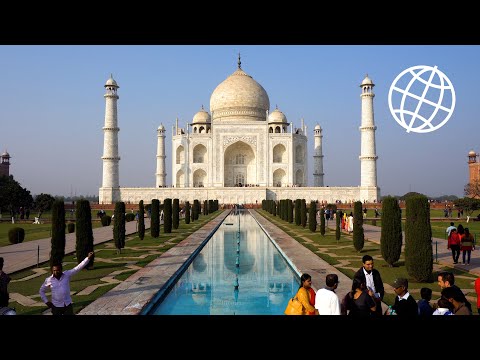
Nestled on the banks of the River Yamuna in Agra, India, the Taj Mahal is not just a monumental labor of love but a symbol that transcends time and art to stand as one of the world’s most remarkable architectural feats. Recognized universally as a masterpiece of world heritage, it draws millions of visitors each year, eager to witness its sublime beauty and historical grandeur in stunning 4K clarity.
## Architectural Marvel
Constructed between 1632 and 1653 under the patronage of Mughal Emperor Shah Jahan, the Taj Mahal was built in memory of his beloved wife Mumtaz Mahal, who died during childbirth. This immense white marble mausoleum is considered the finest example of Mughal architecture—a style that combines elements from Persian, Islamic, and Indian architectural styles.
The structure is symmetrical and harmoniously balanced. The main gateway is a monumental structure crafted in red sandstone and adorned with intricate calligraphy quoting verses from the Quran. The gateway serves as an entry to another world—away from the chaos of life into a paradise defined by geometric perfection and tranquil ambiance.
## Cinematic Wonderland
Visiting the Taj Mahal is like stepping into a cinematic wonderland especially when viewed through a 4K lens which captures every detail with incredible clarity. The pristine white marble shimmers under the sun’s rays, turning golden at dawn, milky white during midday and mystically luminescent under moonlight. Filmmakers and photographers find this change in hue an enchanting element for their visuals—each moment at Taj offers a different shade, a fresh perspective.
## Gardens and Surroundings
Surrounding the mausoleum are lush gardens laid out in classical Mughal charbagh style—a quadrant garden divided by walkways or flowing water into four smaller parts. These are further subdivided into smaller sections by pathways, forming an intricate symmetry that reflects the balance seen in the main structure.
In addition to this natural beauty are several other significant structures within the complex including a mosque made up entirely of red sandstone to maintain symmetry with its exact replica on its opposite end—the Jawab—used primarily as an architectural balance.
## Cultural Impact
The Taj Mahal is more than just an architectural masterpiece; it’s also a potent emblem of India’s rich history. It has helped shape Agra’s identity as a city steeped in cultural heritage while promoting tourism significantly. UNESCO designated it as a World Heritage Site in 1983 calling it “the jewel of Muslim art in India”.
## Conservation Efforts
Conservation efforts are ongoing at Taj Mahal to combat threats from environmental factors such as air pollution which tends to yellowing its brilliant marble facade. Restoration projects aim at maintaining its pristine condition while ensuring that modern interventions don’t detract from its historical authenticity.
## Experience It In 4K
For those who cannot visit this magnificent site personally, experiencing it through 4K video tours presents an inviting alternative. These ultra-high-definition visuals offer breathtaking detail and vibrant colors providing an immersive experience akin to being there personally—from observing detailed floral carvings on its walls up close to witnessing its celestial reflection in Yamuna’s waters during sunset—all come alive through your screen.
To wrap up, the Taj Mahal isn’t just about grandeur—it speaks volumes about love immortalized through stone. Its captivating beauty continues to mesmerize visitors both physically and virtually making it not just one of India’s top tourist attractions but also one of mankind’s greatest accomplishments.