
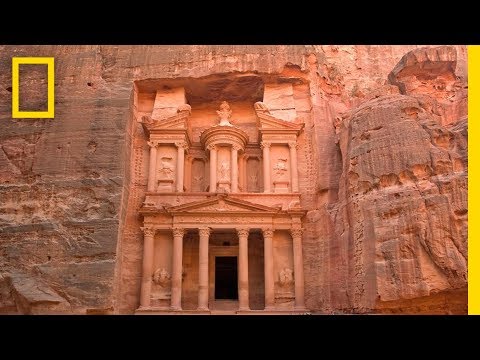
Deep within the rugged desert landscapes of southern Jordan lies Petra, an ancient city that whispers tales of a bygone civilization, the Nabateans, who flourished from the 4th century BCE to the 2nd century CE. Known for its rock-cut architecture and water conduit system, Petra is not just a historical site but a masterpiece of human ingenuity and artistry. This iconic location, recognized as a UNESCO World Heritage site in 1985 and one of the New Seven Wonders of the World in 2007, continues to captivate visitors with its breathtaking beauty and architectural marvels.
#### The Architectural Marvels of Petra
Petra’s most famous monument, Al-Khazneh or The Treasury, stands as a testament to Nabatean engineering excellence. Believed to be constructed in the 1st century BCE as a mausoleum or crypt, this intricately carved facade is an awe-inspiring sight at the end of the Siq—a narrow gorge that serves as the traditional entrance to the city. The precision with which The Treasury is carved from the sheer pink sandstone cliff contradicts its age and continues to mystify archaeologists and architects alike.
Beyond The Treasury, Petra expands into a vast complex of tombs, temples, and ancient living quarters. The Monastery (Ad-Deir), another monumental tomb carved out of rock similar to The Treasury but larger in size, offers an even more stunning example of Nabatean craftsmanship. This monument’s secluded location at the top of an arduous uphill climb is rewarding with panoramic views across the valley and into Israel and Palestine on clear days.
#### Engineering Mastery: Water Conduits
The survival of this ancient city in such a harsh environment was largely made possible by its sophisticated water management system. The Nabateans were pioneers in hydraulic engineering; they constructed channels to control flash flooding and massive cisterns to collect rainwater, ensuring their city thrived amidst droughts. These innovations highlight not only their architectural genius but also their deep understanding of nature’s forces.
#### Cultural Melting Pot
Petra’s architecture reveals influences from various cultures including Greek, Roman, and native Bedouin traditions. This blend is evident in structures like Qasr al-Bint—a temple dedicated to Dushara (a Nabataean deity), which showcases classical facades typical of Roman temples but built using local techniques and designs. This syncretism underscores Petra’s role as a commercial hub where ideas from different cultures met and mingled freely.
#### Preserving Petra’s Legacy
Today, while thousands trek through Petra’s rocky paths each year marveling at its enduring beauty, preserving this ancient wonder poses ongoing challenges. Issues like erosion caused by windblown sand abrasion or damaged caused by flooding are constant threats to Petra’s delicate structures.
Efforts by Jordanian authorities along with international organizations aim to ensure that effective conservation methods are employed without compromising visitor experience or access. Technologies such as 3D scanning are being used increasingly for structural analysis and restoration planning.
#### Experience Petra
Visiting Petra offers more than just visual enjoyment—it provides deep insight into human creativity when faced with environmental challenges; it inspires awe for what can be achieved with limited tools but limitless imagination.
For those planning a visit, walking through Petra at different times can offer varying experiences – from vibrant sunrise hues lighting up The Treasury’s columns to enchanting shadows cast by late afternoon sunsets across royal tombs.
In conclusion,
Petra remains one of our world’s most stunning testimonies to human artistry aligned perfectly with natural landscapes—an eternal stone monument carved not just on land but also into history itself.