
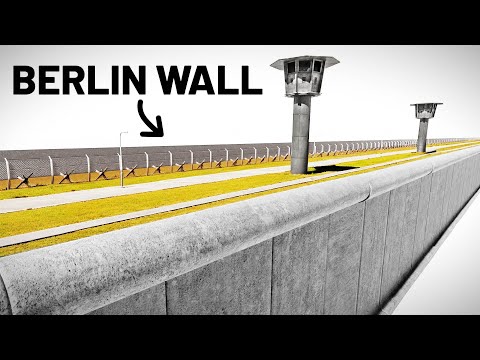
The Berlin Wall, perhaps the most potent symbol of the Cold War’s division of East and West in Europe, stood not only as a physical barrier but also as a stark representation of ideological conflict. Erected in 1961 by the German Democratic Republic (GDR), or East Germany, its primary purpose was to prevent the mass emigration and defection that marked Germany and the communist Eastern Bloc during the post-World War II period.
#### The Origins of the Berlin Wall
After World War II, Germany was divided into four occupation zones managed by the United States, the Soviet Union, Britain, and France. The capital city of Berlin, although situated entirely within the Soviet zone, was similarly divided among the allies. This special status created a loophole that increasingly allowed East Germans disillusioned with communist rule to escape to the West.
By 1961, nearly 3.5 million East Germans had fled to West Germany through Berlin. This exodus included a significant proportion of young professionals – doctors, teachers, and engineers – which drained the communist state of valuable resources and labor power. To halt this brain drain and stabilize its economy, East Germany decided to close off access between East and West Berlin.
#### Construction and Structure
In August 1961, overnight, East German troops laid down more than 30 miles of barbed wire barrier that divided West from East Berlin. The initial makeshift construction was later replaced with concrete walls topped with barbed wire stretching over 96 miles around West Berlin’s perimeter.
The wall itself varied in construction materials from one section to another but generally consisted of concrete slabs between steel mesh fencing, watch towers placed at strategic intervals, anti-vehicle trenches on either side to prevent any form of vehicular breakthroughs, guard dog runs, floodlights for night surveillance, and a smooth pipe at the top intended to make scaling it more difficult.
#### Functioning Mechanism
The functionality of the Wall extended beyond its physical components. It operated under strict surveillance by East German guards who were ordered to prevent escapes by any means necessary—including lethal force. The so-called “Death Strip” was a sand-covered strip running between two walls built at varying distances apart; it provided guards with a clear line of fire at fleeing individuals.
Furthermore, crossing points like Checkpoint Charlie became iconic confrontational stands between superpowers yet also served as controlled passages for diplomats and allied officials under strict scrutiny. Despite these measures being in place for security purposes under GDR claims that it was an “Anti-Fascist Protection Rampart,” Western ideological interpretations suggested it represented oppression instead.
#### Impact on Society
The psychological impact on Germans living in both sides was profound; families were split apart overnight as many found themselves suddenly trapped on one side or another based on where they had been during construction. Life went on under constant supervision where privacy seldom existed; every aspect from mail to phone calls often being monitored by Stasi (East German Secret Police).
#### Fall Of The Wall
By 1989 dissipating political power in Eastern Europe influenced by Mikhail Gorbachev’s policies like Perestroika (restructuring) and Glasnost (openness) led Hungary to remove its physical border restrictions with Austria causing an outpouring chain reaction among other Eastern Bloc states including Poland Czechoslovakia ultimately reaching GDR citizens demanding reform or free passage rights against their government which culminated on November 9th when unexpected announcements regarding easing travel restrictions caused thousands to surge towards freedom leading guards overwhelmed simply stepped aside letting people hammer away chunks marking an end era thus setting stage unification Germany following year.
#### Conclusion
In retrospect while initially erected prevent destabilization through population loss ended up serving different roles over decades existence both barrier division emblem courage face oppression widely remembered not just architectural feat but cultural landmark illustrating stark difference philosophies ideologies governed divided world during cold war era hence why considered important pieces history understanding global political landscape today.