
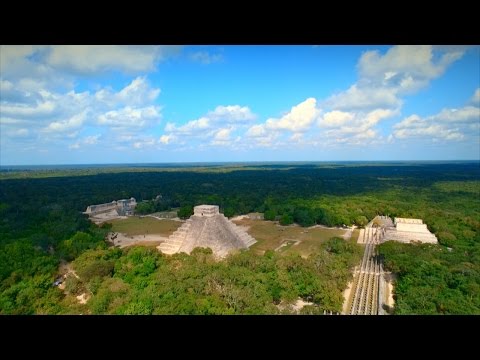
One of the most iconic symbols of Pre-Columbian Mexico, Chichen Itza’s El Castillo, also known as the Temple of Kukulcan, stands as a testament to the architectural and astronomical expertise of the ancient Maya civilization. However, recent technological advancements and ongoing archaeological studies have revealed a fascinating secret about this famous pyramid: it is not just a single structure but rather a series of two pyramids built one atop the other.
#### The Discovery
The discovery was made possible through the use of non-invasive imaging techniques such as tri-dimensional electric resistivity tomography (ERT-3D) and ground-penetrating radar. These methods allow archaeologists to explore beneath the surface of ancient structures without damaging them. Upon examining El Castillo, researchers were surprised to find that it encapsulates an earlier, smaller pyramid within its massive stone walls.
#### The Inner Pyramid
The inner pyramid, much like its outer shell, is a step pyramid with a temple at the top. This substructure has dimensions significantly smaller than those of the outer pyramid. The inner temple contains an altar and possibly served as an important ceremonial space for Maya elite. It likely held socio-political or religious significance that warranted its encapsulation rather than destruction.
#### Architectural Significance
This configuration is not unique in Mesoamerica; nested structures are quite common in region’s architecture. Such constructions are thought to be indicative of various phenomena including political change, evolving religious practices or even advancements in astronomical knowledge. Each layer added to a pyramid could signify a new era, ruler, or major societal change.
#### Astronomical Alignment
El Castillo is famously known for its alignment with celestial events. Twice each year on the spring and autumn equinoxes, the setting sun casts shadows along one side of the staircase creating the appearance of a serpent slithering down the pyramid. This effect is enhanced by stone carvings that resemble snake heads at the base of the stairs. The existence of two pyramids one inside another raises questions about whether this astronomical alignment was originally intended for both structures or if it was perfected only when the final form was complete.
#### Cultural Importance
For contemporary Maya people and Mexico at large, discoveries like this reinforce cultural pride in their ancestors’ ingenuity and sophistication. Every new piece of information adds depth to our understanding of Mayan civilization—which far from being static or isolated—was dynamic and interconnected with other regional cultures.
#### Future Explorations
The revelation that El Castillo consists of multiple layers suggests there might be more secrets waiting to be uncovered not only within this structure but potentially in other Mesoamerican pyramids as well. Continued technological advancements promise even deeper insights into these ancient wonders without risking damage to their structural integrity.
As researchers delve further into understanding Chichen Itza’s layered pyramids, we are reminded once again how much there is yet to learn about ancient civilizations. Each discovery peels back a layer of history revealing more about human ingenuity across ages—a journey into past that continually enlightens our present.