
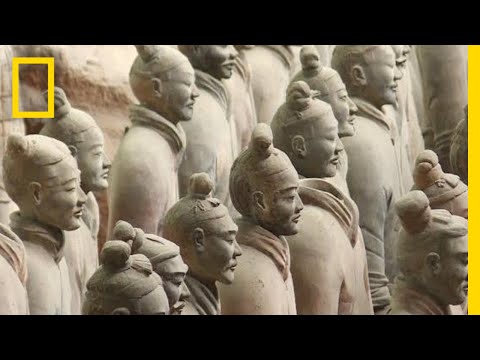
In the sweeping plains surrounding Xi’an in Shaanxi Province, one of the world’s most breathtaking archaeological discoveries continues to captivate historians and tourists alike: the Terra-Cotta Warriors. Unearthed in 1974 by local farmers digging a well, this monumental discovery has been dubbed as one of the greatest archaeological finds of the 20th century. The site reveals an army of over 8,000 life-sized clay soldiers buried alongside China’s first emperor, Qin Shi Huang, ostensibly to protect him in the afterlife.
### The Genesis of a Necropolis
The story begins with Emperor Qin Shi Huang, renowned for unifying China for the first time in 221 BCE. His reign brought about significant changes including standardization of weights, measures, and even the script used for writing throughout his empire. However, his quest for immortality led him to commission an elaborate mausoleum guarded by an army — a terra-cotta one.
The construction of this necropolis is believed to have begun shortly after he ascended to the throne at the age of 13 and continued until his death at 49. It is reported that over 700,000 workers labored over this project which sprawled across a vast area.
### Architectural Marvel and Symbolic Guardians
Each warrior stands approximately six feet tall and varies in attire and hairstyle according to rank – a testament to their purpose as individual warriors capable of guarding their sovereign in death as they might have in life. Remarkably, no two faces among them are alike; each figure exhibits unique facial expressions and features—craftsmanship that speaks volumes about ancient Chinese artistry.
The warriors were once painted vividly though much of the pigment has faded or peeled off after millennia underground. X-rays reveal that beneath their clay exterior they are armed with real weapons—bronze swords, spears, bow-and-arrows—some coated with chromium oxide giving them an impressive degree of preservation against rust.
### Mysteries Unraveling Through Modern Technology
Recent excavations and research have employed advanced technologies like remote sensing, ground-penetrating radar, and DNA analysis revealing more about how these figures were constructed—and possibly why they differ so drastically from any other artifacts from that era. Analysis suggests that artisans may have utilized assembly line techniques far ahead of its time during production: forming parts like heads, arms, and legs separately before bringing them together.
Moreover, new pits discovered nearby contain remains suggesting sacrificial rituals took place—highlighting a darker aspect of ancient beliefs regarding death and afterlife.
### Conclusion: An Ever-Unfolding Enigma
Despite decades of research since its initial discovery by those unsuspecting farmers back in 1974 who hoped merely to find water rather than an underground army frozen in time—the full purpose and scope behind Emperor Qin Shi Huang’s terra-cotta army remain only partially understood. Each excavation season brings new findings; each artifact pieced together forms a clearer picture while expanding our questions about this fascinating chapter in human history.
As efforts continue to preserve these relics against both natural decomposition and human interference (like vandalism or theft), the Terra-Cotta Warriors stand not just as sentinels for an emperor long gone but as immutable witnesses speaking silently across millennia about ancient China’s power structure dynamics within life—and beyond death.