
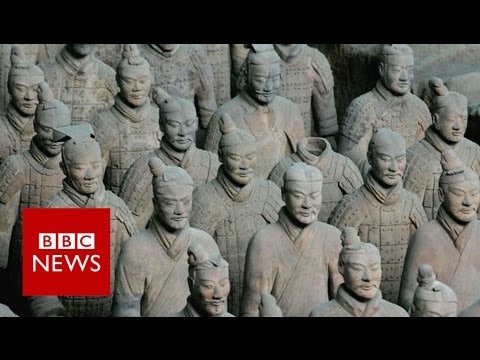
In March 1974, a group of farmers digging a well in Lintong District, Xi’an, Shaanxi province, China, stumbled upon one of the most significant archaeological discoveries of the 20th century: the Terracotta Army. This find not only provided a new understanding of China’s ancient history but also redefined archaeological expectations globally.
The Terracotta Army is part of an elaborate mausoleum created to accompany the first Emperor of China, Qin Shi Huang, into the afterlife. Believed to have been constructed between 246 BC and 208 BC, this vast clay army was buried with Qin Shi Huang, ostensibly to protect him and help him rule another empire in the afterlife.
The figures discovered at the site are life-sized and vary according to military rank, which provides insight into the military practices and hierarchical system of ancient China. Over 8,000 soldiers, 130 chariots with 520 horses, and 150 cavalry horses have been uncovered so far, each with distinct facial expressions and features — no two figures are alike. The craftsmanship highlights an advanced level of skill and an exquisite attention to detail characteristic of that era.
The discovery was immediately recognized for its historical significance. Archaeologists from around the world flocked to Xi’an to study these artifacts. The Terracotta Army has given scholars new insights into Qin Dynasty’s military practices, religious beliefs, and political systems.
In addition to providing a wealth of information about military armaments — from swords still sharp after thousands of years due to their chrome plating technology to intricately designed chariots — the site has also revealed colorfully painted details on these figures which had faded over millennia but could be studied through spectral imaging technologies.
The preservation efforts around this UNESCO World Heritage Site have also prompted advancements in archaeological preservation techniques. Maintaining the condition of terracotta figures when exposed to air after thousands of years underground presents enormous challenges; researchers continue developing innovative methods for preservation.
Furthermore, since its discovery over four decades ago, the Terracotta Army has become an immense source of cultural pride for China as well as a significant draw for tourists from all over the globe. It embodies not only a technical achievement but also underscores the enduring nature of Chinese civilization.
Its discovery in modern times echoes themes familiar throughout history — such as belief in an afterlife and monumental funeral practices — while also providing stark contrasts against contemporary social norms and technological capabilities.
Indeed, few archaeological finds have captured public imagination around the world quite like this one. Scholarly books have been penned on what can be learned from these ancient warriors standing silent guard over their departed sovereign; documentaries and fictionalizations proliferate across various media platforms; exhibitions tour internationally allowing people everywhere a glimpse into this ancient world marvel.
As we continue into the 21st century with new archaeological technologies at our disposal like ground-penetrating radar and digital mapping tools that promise even broader explorations into human history’s material past – including perhaps more yet-to-be-discovered sections or aspects related directly or indirectly to this extensive necropolis – it remains clear that nothing competes with discovering a forgotten terracotta soldier underfoot as one digs through soil layers accumulated over millennia.