
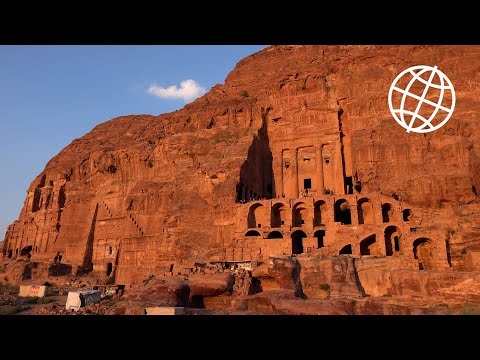
Nestled in the heart of Jordan’s desert landscape lies Petra, an archaeological marvel that has captured the imaginations and hearts of travelers from around the globe. Known as the “Rose City” due to the color of its stone, Petra offers a visual spectacle that is best captured in stunning 4K resolution, revealing intricate details and vibrant colors that bring ancient history alive. This article will guide you through the wonders of Petra, exploring its architecture, historical significance, and what makes it a must-visit destination.
#### Historical Backdrop
Petra’s story begins in ancient times when it was established as the capital city of the Nabataeans around the 4th century BC. This nomadic Arab tribe excelled in water technology, including constructing aqueducts and cisterns, which helped them thrive in the arid desert. Over centuries, Petra grew into a bustling trade center, strategically located on caravan routes that facilitated trade between Asia and Arabia with Egypt and Syria. Its importance is evident from its elaborate architecture and sophisticated urban planning.
#### Architectural Marvels
The journey into Petra leads through the Siq, a narrow gorge flanked by towering cliffs. As visitors traverse this natural corridor, anticipation builds until they are greeted by Al-Khazneh (the Treasury), one of Petra’s most famous monuments. Captured beautifully in 4K resolution videos or images, Al-Khazneh reveals extraordinary Hellenistic architectural elements carved directly out of pink sandstone cliffs.
Beyond Al-Khazneh lies a sprawling city carved into mountainsides and dotted with facades that blend Hellenistic architectural styles with traditional Nabataean elements. Each structure tells a unique story—be it tombs for royal family members or temples for cultural ceremonies—rendered more intimate and detailed through high-definition visuals.
#### Cultural Significance
Petra not only stands as a testament to human ingenuity but also symbolizes cultural confluence. The city’s architecture shows Greek-influenced columns alongside traditional Nabataean motifs—an amalgamation that speaks to multiple interactions through trade and cultural exchange over centuries.
The significance has been recognized globally; UNESCO declared Petra a World Heritage Site in 1985 due to its unparalleled historical value. Additionally, it was named one of the New Seven Wonders of the World in 2007—an accolade that highlights its importance among global heritage sites.
#### Experiencing Petra in 4K
With advancements in technology, experiencing such historical treasures is more immersive than ever before. Viewing Petra in 4K resolution allows for an appreciation of intricate details—the texture of sandstone carvings or delicate line work that may not be as apparent at lower resolutions.
Tourists can virtually wander through this ancient city via online platforms offering video tours or documentaries showcasing these majestic structures with unprecedented clarity; you can practically feel like you’re stepping back into another era—a testament to modern technology meeting ancient grandeur.
#### Conclusion
Visiting Petra is like walking through history pages where every corner holds deep historical narratives waiting to be uncovered. With each detail vividly captured at 4K resolution—from tiny engravings on tomb doors to sweeping views over vast archaeological landscapes—Petra stands out as not just an archaeological site but an unforgettable visual experience.
Whether physically visiting or exploring virtually from afar—thanks especially to stunning visual storytelling capabilities afforded by current technologies—it’s clear why Petra remains one of humanity’s timeless treasures.